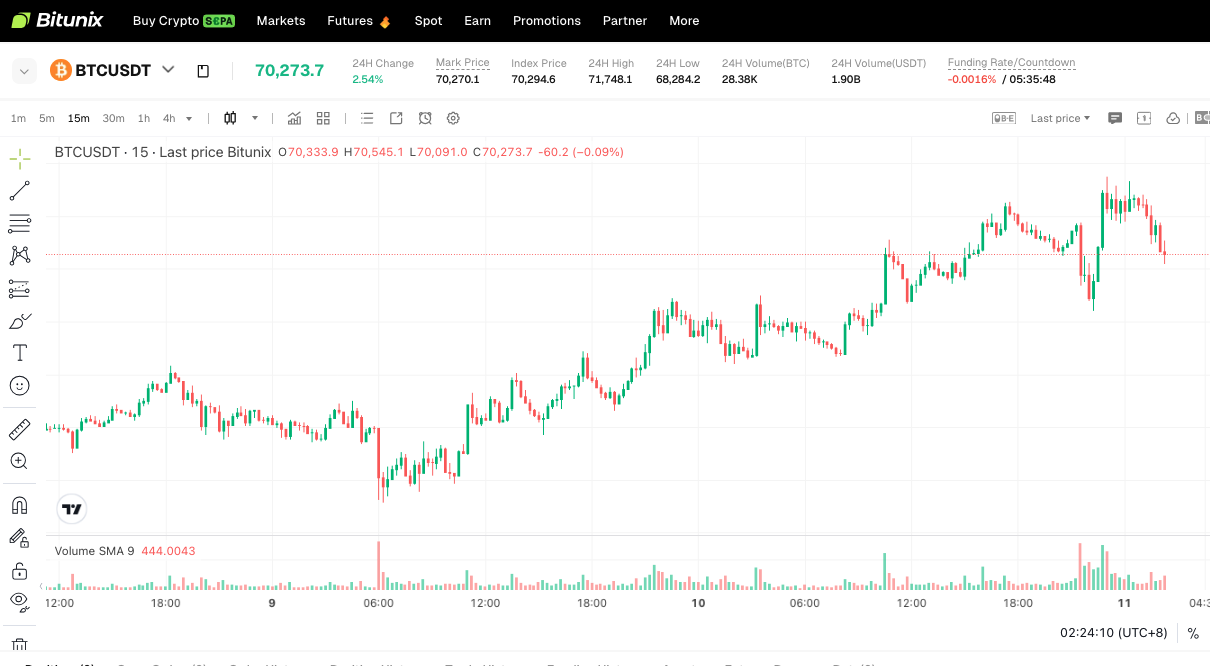
Fees + Funding
Funding rates on perpetuals can be a bigger drag than maker/taker fees if you hold positions. Understand both before trading.
Risk Controls
Isolated vs cross margin, liquidation behavior, and how easy it is to cap exposure per trade. These save accounts.
Execution Quality
Slippage and partial fills matter more than people realize, especially during volatile markets and fast entries/exits.
Usability
A clean, clear interface reduces costly mistakes — especially when managing leverage or adjusting stop-loss levels under pressure.
Promos & Bonuses
Bonuses can be a nice perk, but they should never influence your trading plan, leverage level, or position sizing decisions.
Market Coverage
Some platforms offer hundreds of spot pairs. Others focus on futures. Choose based on what you actually trade, not the largest list.
Bitunix is positioned for active futures and derivatives trading. Most users choose it for the trading-first workflow — not for buying and holding. If your primary activity is futures/perpetuals, the comparison comes down to fees, funding schedules, risk controls, and execution — not brand recognition.
| Category | Bitunix: what to expect | Other exchanges: what to verify |
|---|---|---|
| Best fit | Active futures and derivatives trading focus | Some are broader (spot + many products), some are futures-first |
| Costs | Maker/taker fees plus funding rates on perpetuals | Funding schedules and fee tiers vary significantly — always verify |
| Risk controls | Use isolated margin if you're not advanced — don't default to cross | Some platforms bury risk settings or make exposure harder to manage |
| Beginner safety | Better if you already understand leverage and liquidation mechanics | Even large platforms are dangerous if you oversize leverage |
| Promos | Task-style reward programs available; see Signup Bonus Hub | Promos change frequently and often require specific conditions to unlock |
Bitunix vs Binance
Binance is known for wide market coverage across spot and derivatives. Bitunix is narrower and more futures-focused in its workflow. If you want maximum spot variety, big exchanges may appeal; if you're futures-first, tools and risk controls matter more than size.
More Bitunix comparisons →Bitunix vs Bybit
Bybit is well-established in derivatives. Bitunix also targets futures traders and may appeal based on reward structure or workflow preference. Either way: fees, funding, and discipline decide the outcome — not the logo.
See more comparison context →Bitunix vs KuCoin
KuCoin is a broader exchange with many token listings. Bitunix is more narrowly focused around futures and derivatives trading. The right choice depends on what you actually do — spot investing vs active futures trading are different workflows.
Read Bitunix Review →Choose Bitunix if...
Your main activity is futures or perpetuals trading. You want a platform built around a trading-first workflow. You understand leverage and liquidation risk. You view rewards as a perk, not the primary reason to trade.
Consider other exchanges if...
You want access to a large spot marketplace with hundreds of token pairs. You're brand new to crypto and need beginner-friendly onboarding. You're not comfortable with derivatives, margin calls, or leverage mechanics.
Do not choose based on bonuses alone if it would make you trade more or raise leverage to unlock a reward. The bonus is worth far less than the damage from an oversized position gone wrong.
Signup Bonus Hub
Current welcome rewards and deposit bonuses
View →Referral Code
Referral perks — use before registering
View →Task Center Rewards
Activity-based bonuses inside Bitunix
View →Bitunix Review
Full platform review — is Bitunix legit?
Read →Bitunix Guides Hub
Full library of Bitunix tutorials and articles
View →How to Use Copy Trading
Step-by-step copy trading setup guide
Read →Fees & Futures Basics
Funding, leverage, and liquidation explained
Read →Risk Management Guide
Position sizing, stop losses, and max loss rules
Read →Is Bitunix better than Binance or Bybit?
It depends on your goal. Bitunix is positioned for active futures and derivatives traders with a trading-first workflow. Large exchanges like Binance offer broader spot market coverage and more product types. Bybit is also derivatives-heavy. Compare fee and funding costs, risk controls, and execution — those decide outcomes more than brand name.
What matters most when comparing futures exchanges?
Fees and funding rates, risk controls (isolated vs cross margin), order execution and slippage, liquidation rules, and whether the platform makes it easy to manage position sizing and stop-loss rules. These are the variables that actually affect your P&L. Brand reputation matters far less than most people think.
Should I choose an exchange based on signup bonuses?
Bonuses are a perk, not a strategy. Choose the exchange based on trading tools, safety controls, fees, and whether it matches your actual trading style. Never increase leverage or overtrade just to unlock a reward — the cost of a blown position far exceeds any bonus value.